How to Build Accurate Lead Lists That Convert
Step-by-step guide to define your ICP, collect and enrich leads, verify contacts, and segment lists for better open rates and higher conversions.
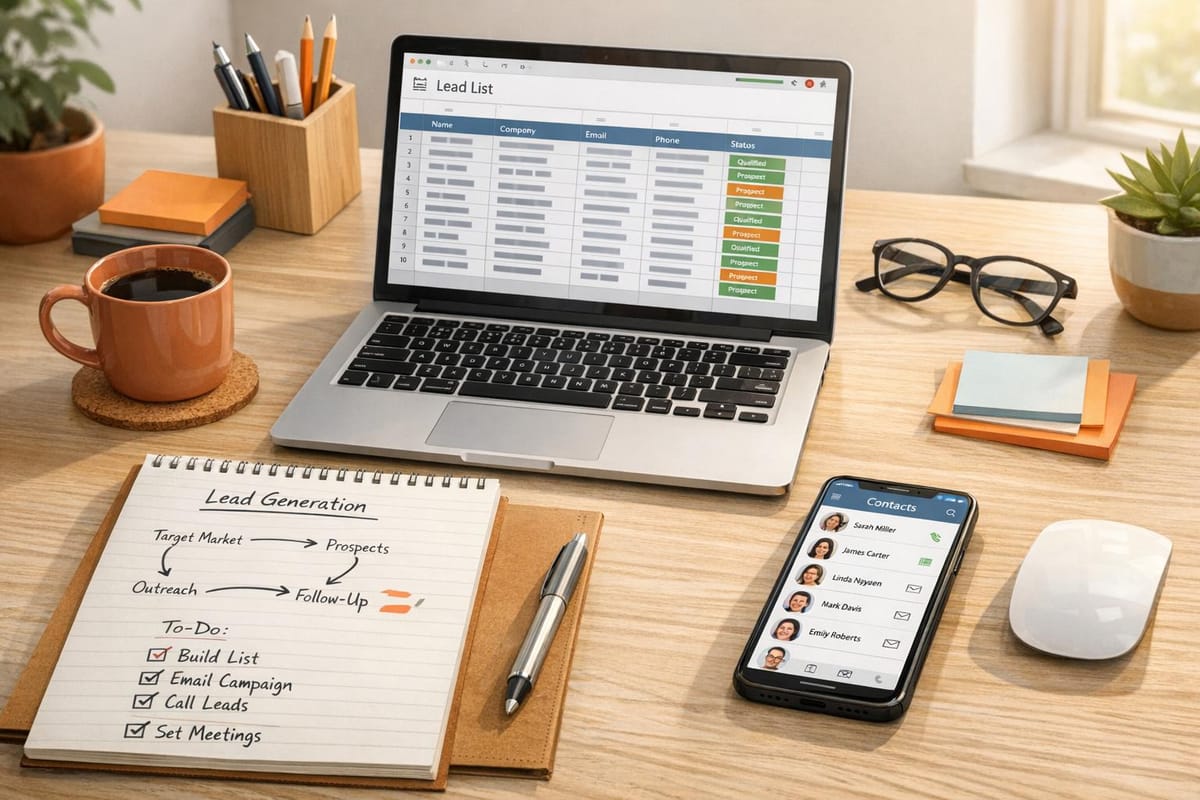
Building a lead list is more than gathering names and emails. It’s about creating a tailored database of potential customers that match your Ideal Customer Profile (ICP). Here’s the process in six steps:
- Define Your Target Audience: Combine firmographics (industry, company size), technographics (tools they use), and intent data (buying signals) to identify ideal prospects.
- Collect Initial Data: Use tools like Apollo.io or LinkedIn Sales Navigator to gather basic company and contact details. Avoid pre-built lists to ensure data quality.
- Enrich Your Data: Fill in gaps with tools like Enrichfox.ai to add emails, phone numbers, and other details. Verified data improves targeting and personalization.
- Validate Your Data: Check emails and phone numbers to ensure accuracy and avoid bounces. High-quality data protects your sender reputation.
- Integrate and Segment: Sync leads with your CRM and organize them by industry, role, or behavior for tailored outreach.
- Test and Improve: Regularly update and refine your lead lists to ensure they remain accurate, actionable, and effective.
Key Stats:
- 23% of emails in typical lists are invalid.
- Data enrichment can increase email open rates by 35% and conversions by 20%.
- Companies with a defined ICP see 38% higher win rates.
Accurate lead lists save time, improve outreach outcomes, and drive better sales results.
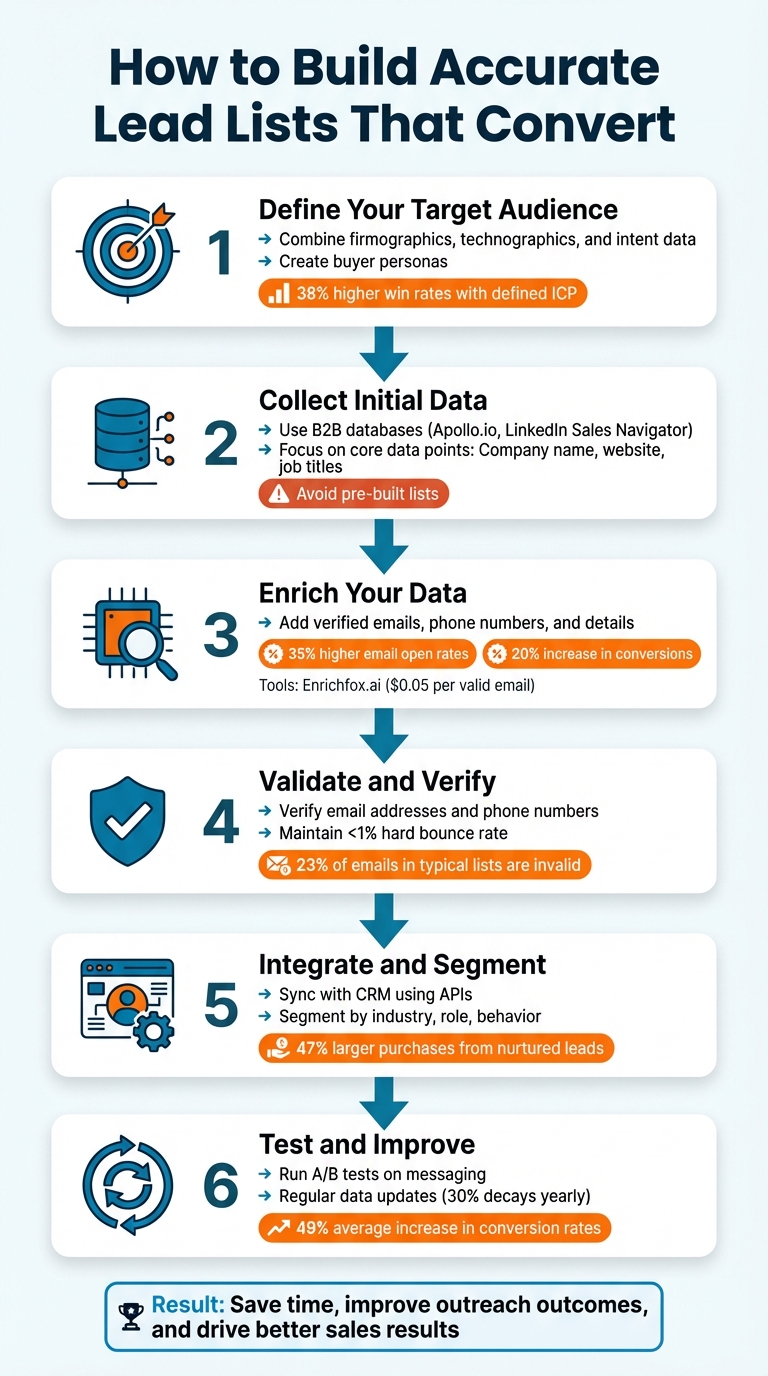
6-Step Process to Build High-Converting Lead Lists
How to Build Your Lead List With Apollo
Step 1: Define Your Target Audience
Before diving into contact data collection, take the time to define your target audience. Skipping this step can lead to wasted resources chasing unqualified leads that don’t align with your business goals.
To pinpoint your audience, combine firmographics (like industry, revenue, and company size), technographics (the technology they use), and intent data (behavioral signals showing active interest in solutions). Together, these insights help you identify the right companies at just the right moment.
Research shows that companies with a clearly defined Ideal Customer Profile (ICP) enjoy higher sales success and better customer retention rates. Adding intent data to your strategy makes an even bigger impact - 97% of intent-driven leads are more likely to convert into pipeline opportunities.
Once you’ve defined your target audience, the next step is developing buyer personas to pinpoint the key decision-makers you need to engage.
Create Buyer Personas
While an ICP outlines the types of companies you should focus on, buyer personas zero in on the individuals within those companies who influence decisions.
Start by analyzing your most profitable and engaged customers. Look for patterns in their firmographics (like company size and industry), demographics (such as job titles and seniority), and psychographics (including their pain points and decision-making habits).
For example, in its early days, Gusto (then ZenPayroll) focused on companies with just six key attributes, like having five or fewer employees and being based in California. This narrow focus allowed them to dominate a niche market before expanding. Similarly, Gong targeted roughly 5,000 software companies in the U.S. that used Webex and sold products with contract values between $1,000 and $100,000.
"We did not think about ICP. I wish we did earlier on. It's one of my biggest mistakes." - Mathilde Collin, Co-founder and CEO, Front
Tools like ZoomInfo, LinkedIn Sales Navigator (starting at $99/month for the Core Plan), and UpLead (starting at $99/month) can help you find prospects that match your ICP. These tools also provide technographic and intent data to enrich your insights. To truly understand your customers’ buying processes and pain points, don’t rely solely on assumptions - reach out and interview your most successful clients directly.
Match Lead Lists to Business Goals
A lead list isn’t a one-size-fits-all solution. Different campaigns and products require distinct audiences, so aligning your leads with specific business objectives is critical for success.
"Your lead list is probably the most important thing you can invest in today. You can have the best script, copy, deliverability, and offer, but if all your efforts target the wrong audience, you'll not close any deals." - Habib Benabdeslam, Datablist
To get the most out of your lead list, filter it carefully at both the company and contact levels. For complex B2B sales, it’s especially important to map out the full buying committee. This includes champions, decision-makers, influencers, and gatekeepers, rather than focusing on just one contact.
Here’s a real-world example: Between 2023 and 2024, SalesBread partnered with Purple.ai to target IT firms. From a broad list of 20,000 companies, they narrowed it down to those serving large venues (like hospitals and stadiums) and offering guest WiFi services. This laser-focused approach resulted in 294 qualified leads, a 41% average reply rate, and a deal with Smart Communications.
This level of precision works hand in hand with data enrichment to ensure every outreach effort is purposeful. Use sales triggers to time your outreach effectively. Look for events like funding rounds, leadership changes, job postings, or market expansions. Research shows that companies contacting leads within one hour of an intent signal are nearly seven times more likely to qualify them. Segment your lists by industry or use case - for instance, one list for SaaS companies and another for manufacturing - so you can tailor your messaging to address their unique challenges.
Step 2: Collect Initial Lead Data
After defining your target audience, the next step is to gather raw lead data. Focus on collecting only the essential information that helps identify the right companies and contacts. This foundational data plays a critical role in ensuring higher conversion rates down the line.
A two-stage filtering process works best: first, pinpoint the right companies (account-level filtering), then identify the right individuals within those companies (contact-level filtering). This approach saves time and resources by narrowing your efforts to leads that match your ideal customer profile.
Efficient data collection not only maximizes your selling time but also ensures you're starting with high-quality prospects. Let’s dive into some practical ways to gather this crucial lead data.
How to Collect Raw Data
There are several ways to gather initial lead data, each with its own balance of ease, quality, and compliance considerations.
- B2B Databases: Platforms like Apollo.io and Hunter Discover allow you to filter for specific firmographics such as location, industry, and employee count. Apollo.io alone provides access to over 270 million verified B2B contacts. These tools are user-friendly and often GDPR-compliant, as they source data from public web records and offer opt-out options.
- LinkedIn Scraping: With over 1 billion profiles, LinkedIn is one of the richest sources for professional data. Tools like Phantombuster, Waalaxy, and Dux-Soup (starting at $10/month) automate data extraction from LinkedIn Sales Navigator. Using cloud-based scrapers can lower the risk of account bans since they don’t rely on your account cookies.
- Online Directories: For niche industries, directories like G2 and Capterra (for software companies), Clutch.co (for agencies), or EdSurge (for EdTech businesses) can be valuable. These sources often include unique data points not found in larger databases, though manual scraping can be time-intensive.
- Inbound Lead Generation: Capturing leads through content offers like ebooks, webinars, or gated resources ensures you’re engaging with prospects who have already shown interest. While inbound leads typically cost 61% less than outbound leads, they may require additional enrichment to build a complete profile.
Avoid buying pre-built lists. These are often outdated, riddled with unverified emails, and can harm your sender reputation, leading to poor results.
| Method | Ease of Use | Data Quality | Compliance Risk |
|---|---|---|---|
| B2B Databases | Easy; quick access | High (if web-sourced) | Low (opt-out provided) |
| LinkedIn Scraping | Moderate; needs tools | High; very current | Moderate (risk of bans) |
| Online Directories | Challenging to scale | High; unique data | Moderate |
| Inbound Marketing | Time-intensive | Superior; high conversion | Very Low |
| Pre-built Lists | Very Easy | Low; often outdated | High |
When gathering data, prioritize compliance with regulations like GDPR and CCPA. This includes having a legitimate business interest for data collection, safeguarding personal information, and offering clear opt-out options during outreach.
Focus on Core Data Points
Starting with the basics makes later enrichment more efficient and cost-effective. Most enrichment tools need at least a Company Name and Website Domain to append firmographic data, or a Name and Company Domain to locate a professional email address.
Organize your initial data collection into two categories: Account Information (company details) and Prospect Information (individual contact details).
- Account Information: Gather details such as Company Name, Website/Domain, Industry, Company Size (employee count), and Headquarters Location. The company’s website domain is especially important since most enrichment tools rely on it to find verified contact information.
- Prospect Information: Focus on Full Name, Job Title, Seniority Level, and LinkedIn Profile URL. These details help you determine whether the prospect fits your ideal customer profile before investing in deeper enrichment, like finding verified emails or phone numbers.
"Filtering is everything. A successful event required careful, multi-layered preparation." – Habib Benabdeslam, Datablist
Before enriching your data, clean it to improve accuracy and match rates. Fix typos, standardize company name formats (e.g., remove “Inc.” or “LLC”), and ensure consistency across your dataset. This simple step prevents errors during the enrichment process.
Keep in mind that 70.3% of B2B data becomes outdated every year. Even high-quality initial data needs regular updates and verification. Starting with accurate, essential data points lays the groundwork for the next step: enriching your lead lists with detailed, actionable contact information.
Step 3: Enrich Your Lead Data
Enriching your contact data means filling in the gaps in your lead profiles with critical details like verified email addresses, direct phone numbers, job titles, company revenue, and even the technologies they use. This process transforms incomplete records into detailed profiles, making it easier to target prospects effectively and personalize your outreach campaigns. By replacing outdated or missing information with fresh, verified data, you’re setting your team up for success.
Why does this matter? The numbers speak for themselves. Data enrichment can boost marketing ROI by 29%, improve customer retention by 36%, and contribute to the personalization that many fast-growing companies credit for 40% of their revenue. Plus, with about 2% of CRM data becoming outdated every month, consistent enrichment is essential to keep your lead lists accurate and actionable. Accurate data also ensures precise segmentation, setting the stage for seamless CRM integration later on.
Use Bulk and API Enrichment
Start by cleaning your data and identifying the key fields that align with your Ideal Customer Profile. This helps you focus your budget where it matters most. There are two main ways to enrich your data: bulk enrichment and API enrichment. Each method caters to different workflows and data volumes.
- Bulk enrichment: This method is perfect for processing large datasets. Simply upload a CSV file to a platform like Enrichfox.ai, Apollo.io, or Clay, and let the tool work its magic. For example, if you've scraped 5,000 LinkedIn profiles and need their email addresses, bulk enrichment can handle the task in minutes, adding verified emails, phone numbers, and firmographic details.
- API enrichment: This approach provides real-time updates by integrating enrichment tools directly into your CRM - whether it’s Salesforce, HubSpot, or another platform. Whenever a new lead enters your system, the API automatically enriches their data with additional details. This “always-on” method not only keeps your data current but also saves your team time by automating the process.
"Apollo enriches everything we have...and we don't really have to touch it, it just works" - Mark Turner, VP of Rev Ops at Built In
For even more accuracy, consider waterfall enrichment. This technique checks multiple data providers in sequence until it finds a verified match. It’s especially useful for reaching prospects who are harder to track down. Tools like Clay excel at this by combining data from various sources to improve match rates.
Enrichfox.ai vs. Competitors
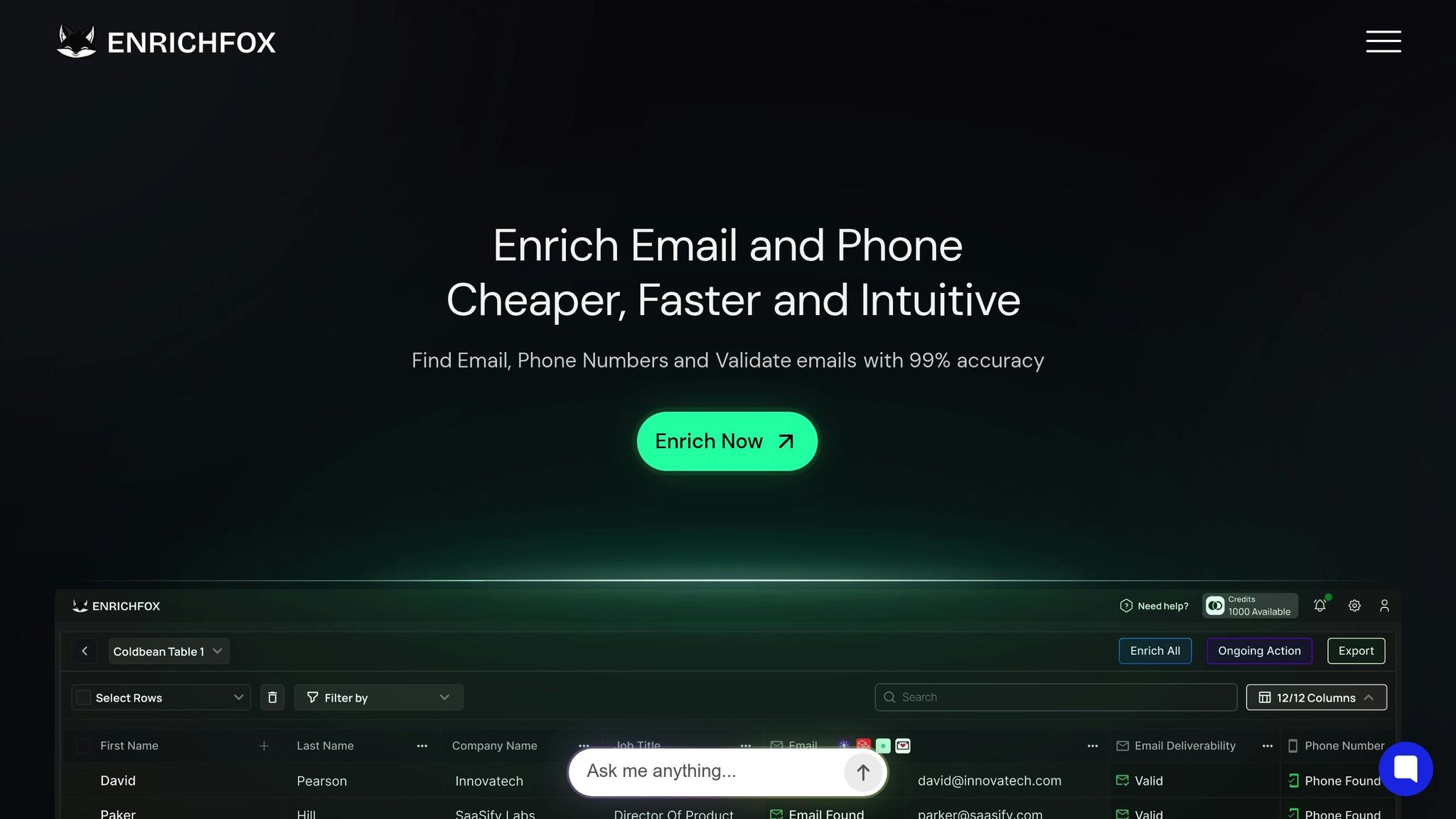
Once you’ve decided on your enrichment method, the next step is choosing the right tool. Here’s how Enrichfox.ai compares to other leading options:
| Tool | Primary Strength | Database Size | Pricing Model | Best For |
|---|---|---|---|---|
| Enrichfox.ai | 99% email accuracy; pay-per-result | Not specified | $0.05 per valid email; $0.03 per valid phone | Small to mid-sized teams looking for cost-effective accuracy |
| Apollo.io | All-in-one platform with engagement tools | 275M+ contacts | $49/month for 1,000 exports | SMBs needing both prospecting and enrichment tools |
| ZoomInfo | Detailed org charts & verified direct dials | Large B2B database | Custom pricing | Enterprises needing in-depth company intelligence |
| Clay | Waterfall enrichment & AI-powered research | Combines multiple sources for better match rates | $149/month for 2,000 credits | Teams focused on maximizing data coverage |
| Clearbit (Breeze) | Marketing automation and lead scoring | 389M+ records | $30-$700/month credit packs | HubSpot users seeking native integration |
Enrichfox.ai stands out with its pay-per-result pricing model. You only pay $0.05 for each valid email, $0.03 for a valid phone number, and $0.00025 for email verification. This ensures you’re not wasting money on failed enrichment attempts, making it an ideal choice for startups and growing sales teams.
Finally, don’t underestimate the importance of email verification. Poor data quality costs U.S. businesses an estimated $3.1 trillion annually, and sending emails to invalid addresses can hurt your sender reputation and land you in spam folders. Always verify enriched contacts before launching outreach campaigns.
Step 4: Validate and Verify Your Data
Once you've enriched your data, the next crucial step is validation. This ensures your outreach efforts target only active, verified leads. Skipping this step can harm your sender reputation and waste valuable resources. For instance, if your hard bounce rate exceeds 1%, email providers may flag your messages as spam or even blacklist your domain.
Refining your data quality can significantly improve campaign results - by as much as 30% - through sharper targeting. Here's an example: if you're currently booking 10 meetings from 1,000 emails (a 1% meeting rate), improving data accuracy and doubling that rate to 2% could yield 10 extra meetings, potentially driving substantial revenue growth.
"Your outbound lives or dies on data quality." - Hans Dekker, Instantly.ai
This naturally brings us to specific methods for validating email addresses and phone numbers.
Validate Email Addresses
Email validation ensures that your messages reach the right inboxes. This process involves checking email syntax, verifying domains and MX records, identifying disposable addresses, and running SMTP diagnostics. Tools like Enrichfox.ai, Verifalia, and Apollo.io can differentiate between soft bounces (temporary issues like full inboxes) and hard bounces (permanent failures). For example, Verifalia's AI-powered system boasts 99% accuracy, while RocketReach reports a 90–98% deliverability rate on verified emails .
You have two main options for email validation:
- Real-time verification: Integrate widgets or APIs into sign-up forms to catch typos and fake entries as they happen.
- Bulk verification: Upload existing email lists (CSV or Excel files) to identify risky addresses, spam traps, and honeypots before launching campaigns.
For example, Enrichfox.ai offers email verification services at just $0.00025 per email. Advanced tools can also handle catch-all domains, reducing the risk of soft bounces. To maintain accuracy, re-verify active segments every 90–180 days and deduplicate your lists quarterly.
Verify Phone Numbers
Validating phone numbers is equally important for optimizing cold calls and SMS outreach. This process often includes carrier lookups to confirm active numbers and filtering against Do Not Call (DNC) lists to ensure compliance with regional regulations. Premium services like Cognism even employ human researchers to manually verify mobile numbers, which can triple the rate of live connections.
A particularly effective method is waterfall enrichment, where tools like BetterContact and Datablist sequentially check multiple data providers to locate verified mobile numbers. This approach maximizes both coverage and accuracy. For example, ZoomInfo's database contains over 65 million phone numbers, while Cognism's manually verified numbers connect sales teams with 87% of their target list .
Browser extensions can also help by pulling phone numbers directly from LinkedIn profiles or company websites in real time. When working in regulated markets, always implement DNC filtering to avoid compliance issues.
Since B2B data tends to decay quickly, make it a habit to cleanse your lists quarterly or biannually .
Step 5: Integrate and Segment Your Leads
Once your data is validated, the next move is to integrate those enriched leads into your CRM and organize them for targeted outreach. Even the most accurate data won’t work its magic if it just sits there unused.
Connect to Your CRM with APIs
Most modern enrichment tools come with built-in integrations for popular CRMs like Salesforce and HubSpot, which means you can skip the hassle of manual data entry. These integrations automatically sync enriched data - like firmographics, technographics, and behavioral signals - into your CRM as soon as a lead is captured. For real-time updates, API and webhook integrations are game-changers. They ensure that data is verified and injected directly into your CRM without delay. This automation not only saves time but also prevents outdated information from creeping in. And that’s a big deal - poor CRM data management costs U.S. businesses over $3 trillion a year.
If you're juggling multiple tools, platforms like Zapier or Workato can streamline the process, automating your entire lead lifecycle. Once the data is seamlessly in place, you’re ready for the next step: segmentation.
Segment Leads and Score Prospects
After your enriched data is in your CRM, it’s time to organize it in a way that makes targeting easier and more effective. Start by segmenting leads based on a combination of account-level firmographics and contact-level details. This ensures your outreach is laser-focused.
Lead scoring is another key strategy. By combining firmographic data with behavioral signals, you can prioritize leads that align with your Ideal Customer Profile (ICP) and show the most engagement. For example, intent-driven leads are 97% more likely to generate pipeline opportunities than those without intent signals. Setting up a scoring threshold - say, 80 or higher - can automatically route high-quality leads from marketing to sales.
You can take it a step further by layering in technographic data, grouping leads by their existing tech stack. This lets you tailor your messaging to their specific needs. Companies that use personalized approaches like this attribute 40% of their revenue to these efforts. And with 80% of buyers expecting tailored experiences, segmentation isn’t just nice to have - it’s a must. It also pays off: nurtured leads often make purchases that are 47% larger than those from non-nurtured leads.
"42% of sales professionals say low-quality leads make selling more of a challenge than it was a year ago." - State of Sales Report
Step 6: Test and Improve Your Lead Lists
Creating a precise lead list isn’t a one-and-done task - it’s an ongoing effort that thrives on regular testing and updates. By refining your approach through testing, you can build on earlier steps like targeting, enrichment, and validation to drive better conversion rates. In fact, companies that actively engage in A/B testing report an average 49% increase in conversion rates. However, keep in mind that only 1 in 8 A/B tests typically produce statistically significant results, so it’s crucial to test strategically and measure outcomes effectively. This process works hand-in-hand with the segmentation and integration strategies covered earlier.
Run A/B Tests and Track Metrics
Focus your tests on elements that directly influence conversions. For instance, experiment with email subject lines, lead form lengths, and call-to-action (CTA) buttons. Small tweaks can lead to big results: changing landing page headlines can improve conversions by 10%–30%, while optimized CTA button text can boost them by 21%. Additionally, lead forms with just 3–5 fields tend to convert 20%–25% better than those with 10 or more fields.
To get meaningful insights, test one variable at a time and closely track metrics like conversion rates, lead quality, and sales-qualified lead (SQL) rates. Segment your audience - such as small businesses versus enterprises, or decision-makers versus influencers - to uncover what resonates best with each group. Aim for at least 100 conversions per variation to ensure your results are statistically reliable.
While A/B testing sharpens your messaging, keeping your lead data fresh is just as important for long-term success.
Keep Data Updated with Regular Enrichment
Even a well-curated lead list begins to lose accuracy the moment it’s created. Around 30% of CRM data becomes outdated every year due to job changes and company shifts. To maintain accuracy and deliverability, regular data enrichment is essential. Insights from A/B tests can also help pinpoint which segments need more frequent updates.
Set up automated workflows to refresh your data in real time. Many CRMs already support real-time enrichment tools to help maintain data accuracy. If real-time updates aren’t an option, schedule quarterly refreshes for critical segments to counteract data decay. Keep an eye on bounce rates - high bounce rates often signal stale data and can harm your sender reputation. Before launching major campaigns, take the extra step to deduplicate your list and verify email addresses to maximize deliverability.
Conclusion
Creating accurate lead lists is all about reaching the right people at the right time. At the heart of every successful lead list is a well-defined ICP (Ideal Customer Profile). This sharp focus on targeting lays the groundwork for effective data enrichment and validation. Before diving into enrichment, filter prospects at both the account and contact levels. Then, validate every email and phone number to safeguard your sender reputation and ensure high deliverability rates.
Data enrichment takes basic contact details and turns them into actionable buyer profiles. Businesses leveraging enriched data have seen 35% higher email open rates and a 20% increase in lead-to-customer conversions. Regular data maintenance is key to keeping your lists accurate and your campaigns impactful.
For budget-friendly lead management, tools like Enrichfox.ai offer email enrichment at just $0.05 per valid email and phone number validation for $0.03 per valid number, boasting an impressive 99% accuracy rate. Integrating such tools into your strategy can significantly enhance your data quality and campaign performance.
The process of building and maintaining lead lists is a continuous cycle. The six steps outlined - defining your audience, collecting data, enriching records, validating contacts, syncing with your CRM, and ongoing testing - work together to transform raw data into actionable insights. By zeroing in on high-potential prospects, tailoring your outreach with enriched data, and keeping your lists up-to-date, you can turn your lead lists into a powerful driver for conversions. Precision and consistent improvement are the keys to success.
FAQs
Why is it important to define an Ideal Customer Profile (ICP) before creating a lead list?
Defining an Ideal Customer Profile (ICP) is a game-changer when it comes to targeting the right prospects. By pinpointing key characteristics like budget, company size, industry, location, and buying patterns, you can zero in on the audience most likely to convert. This sharp focus helps you avoid wasting time on leads that don’t fit, while empowering your sales and marketing teams to create personalized messaging and outreach strategies that truly connect with the right people.
An ICP doesn’t just improve targeting - it also enhances efficiency and boosts your return on investment (ROI). When you know which accounts align with your business goals, you can focus on high-value leads and allocate resources where they matter most. This reduces the costs tied to chasing unqualified prospects and ensures your outreach is relevant, leading to faster sales cycles and a more productive pipeline.
Beyond targeting, an ICP shapes your overall strategy. It helps you choose the right data-enrichment tools, fine-tune outreach cadences, and maintain a strong, high-quality pipeline. With a clear ICP in place, you can validate contact information, prioritize efforts, and consistently hit your sales goals.
How does data enrichment help improve email open rates and conversions?
Data enrichment takes a basic email address and turns it into a complete prospect profile by adding details like job titles, company information, industry specifics, and even buying signals. With this extra layer of information, marketers can craft personalized subject lines and email content that speak directly to the recipient’s role, challenges, or needs. When emails feel relevant and tailored, open rates go up, and bounce rates drop - thanks to verified and accurate contact data.
This enriched data also powers precise audience segmentation and keeps lead lists updated in real-time. For sales teams, this means reaching the right prospects at the right moment with messages that truly connect. Research shows that personalized B2B emails outperform generic campaigns, making enriched contact data a crucial factor in boosting both engagement and conversions.
Why is it essential to keep lead data accurate and up-to-date?
Keeping your lead data accurate and current is essential for boosting sales performance and maintaining a steady flow of potential customers. Regularly updating your database ensures contact details are correct, which helps lower bounce rates and avoids wasting time on ineffective outreach.
When your data is validated and enriched, it also improves personalization. This means you can craft messages that resonate more deeply with your prospects, making it easier to build trust and increase conversion rates. Over time, this approach not only enhances customer relationships but also drives revenue. By focusing on data accuracy, your team can dedicate their energy to high-quality leads that are more likely to turn into loyal customers.