Real-Time Data Validation for Lead Management
Validate and enrich leads instantly at entry to reduce bounces, cut marketing waste, ensure compliance, and keep your CRM accurate.
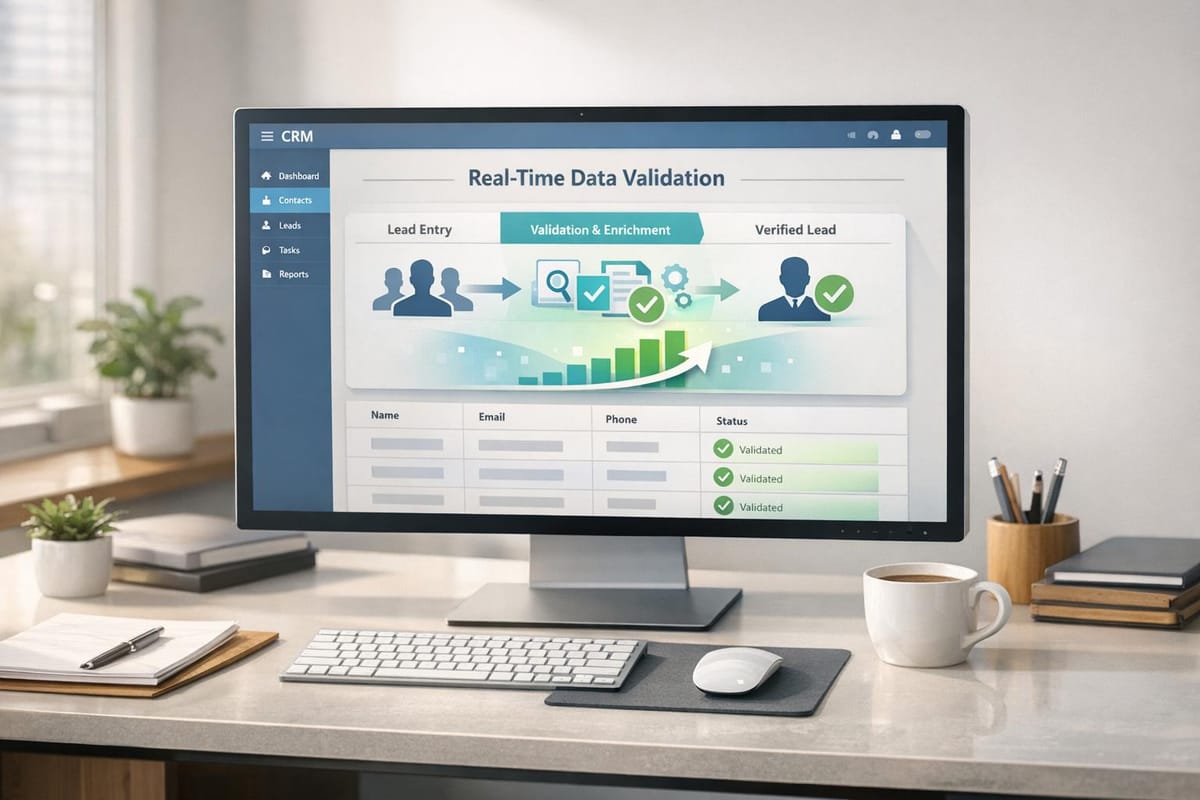
Tired of outdated lead data wasting your time and budget? Real-time data validation fixes this by verifying lead information instantly as it’s entered into your system. This approach ensures accurate, reliable data, reduces marketing waste, and keeps your CRM clean.
Why It Matters:
- 70.3% of B2B data decays annually - leading to bounced emails and wasted resources.
- Real-time validation prevents errors upfront, unlike bulk validation done later.
- It helps you avoid compliance risks (e.g., GDPR, CAN-SPAM fines) and boosts sales efficiency.
Key Benefits:
- Accurate Data on Entry: Fixes errors immediately, ensuring leads are valid and reachable.
- Cost Savings: Stops wasted spend on invalid or unqualified leads.
- Compliance Assurance: Meets legal requirements like GDPR and CASL.
- Stronger Sales-Marketing Trust: Teams work confidently with reliable data.
How It Works:
- Validation: Checks formatting (e.g., email syntax, phone digits).
- Verification: Confirms data accuracy using APIs (e.g., Twilio, Hunter).
- Customizable Rules: Tailor checks for different lead types (e.g., demo requests vs. newsletter signups).
- APIs: Enable instant, behind-the-scenes validation without slowing user experience.
Tools to Use:
Top options include Apollo.io (starting at $49/month), ZoomInfo ($15,000/year for enterprises), and Enrichfox.ai (pay-as-you-go, $0.05 per valid email). Each tool offers different strengths, from bulk enrichment to LinkedIn prospecting.
Takeaway:
Real-time validation isn’t just about clean data - it’s about smarter workflows, better ROI, and avoiding legal risks. Start by integrating validation tools with your CRM, set clear rules, and monitor data quality regularly. With decaying B2B data, keeping your leads accurate is no longer optional - it’s essential for success.
How Can You Automate Data Validation Checks? - The Friendly Statistician
Core Techniques for Real-Time Data Validation
Real-time data validation uses a combination of techniques to ensure your lead database stays accurate and reliable. These methods help you catch errors as they happen, preventing them from harming your campaigns.
Automated Data Verification
Automated verification happens in two main steps. First, it checks for basic issues like syntax and formatting errors - quickly flagging typos or accidental mistakes.
The second step dives deeper, using APIs like Twilio (for phone numbers) or tools such as ZeroBounce and Hunter to validate data. These tools confirm whether an email address not only looks correct but actually exists, weeding out "ghost" leads that could cause bounces later on. Some systems also use OTPs (one-time passwords) to verify contact ownership, though this approach can sometimes reduce form completion rates. Additionally, real-time de-duplication scans for duplicate entries - matching details like email addresses or LinkedIn profiles to prevent redundant records from cluttering your CRM.
Customizable Validation Rules
Not all leads need the same level of validation, and that's where customizable rules come in. These rules let you set specific criteria for different types of leads. For instance, you might require a valid job title and company size for demo requests but only an email address for newsletter signups.
Custom rules also help standardize inputs - like ensuring "New York" and "NY" are treated consistently - and allow you to prioritize trusted data sources. You can even enforce compliance checks, such as ensuring GDPR consent is collected. By integrating these rules with APIs, you can automate the process, making it seamless and efficient.
API Integrations for Instant Data Validation
APIs take automated and customizable validation to the next level by enabling real-time checks. When someone submits a form, the API instantly sends the data to a validation service, gets a response, and either accepts or rejects the submission - all in milliseconds.
Many APIs work asynchronously, providing an enrichment ID right away and delivering the final validation results via a webhook. They’re designed to handle high volumes of data with minimal delays. Whether you use no-code platforms, native CRM plugins, or custom webhook setups, API integrations make it easy to display real-time validation statuses. For operations that deal with large volumes, custom webhooks can offer even faster processing and greater adaptability.
What makes API-based validation so effective is its behind-the-scenes operation. Unlike OTPs, which require extra steps from users, these integrations validate data without interrupting the user experience. This ensures higher conversion rates while still maintaining clean, quality data for your sales team.
How to Implement Real-Time Data Validation in Your Lead Management Workflow
Integrating with CRM and Lead Capture Forms
To enhance your lead management workflow, integrate real-time validation directly into your CRM processes.
Start by leveraging no-code platforms like Zapier or Make to link your lead capture forms (such as Typeform or Mailchimp) to verification tools like Hunter. These platforms make it easy to set up automated workflows without needing technical expertise.
For more advanced setups, consider using webhook-driven enrichment. This method updates lead data instantly as it enters your CRM. According to Nirit Braun, Senior Content Strategist at Lusha:
"Webhooks enrich new records instantly, keeping CRMs accurate... ensuring inbound records get enriched before they hit a rep's queue".
This ensures your sales team only works with complete and verified records.
Another approach is invisible API validation, which uses JavaScript or API integrations to validate data behind the scenes. This keeps your forms user-friendly and maintains high conversion rates. For businesses handling large volumes of leads, asynchronous APIs (like those from FullEnrich) are a smart choice. They process data in the background and send updates via webhooks, avoiding bottlenecks and delays.
To balance costs and efficiency, use trigger-based tiers. For instance, apply real-time validation to high-priority leads, such as demo requests, while processing lower-priority leads, like newsletter signups, in batches.
Once your integration is in place, focus on defining clear validation rules and scoring criteria to refine your lead management system further.
Setting Up Validation Rules and Scoring
Effective lead validation combines format checks (e.g., proper email or phone number formats) with verification through third-party APIs to confirm data accuracy.
Establish clear data standards to maintain consistency. For example, standardize job titles so "VP" and "Vice President" are treated the same. Implement a scoring system that evaluates leads based on two factors: fit (how closely they align with your ideal customer profile) and behavior (their engagement levels). Assign grades to leads, such as "A" for fully validated and ready for sales, or "D" for incomplete records that need attention.
Configure your tools to append rather than overwrite data. When enrichment services provide conflicting information with what a lead has entered manually, prioritize the user-provided data. Use validation rules to fill in missing fields instead of replacing existing ones. Additionally, set up a source hierarchy to determine which data provider takes precedence in cases of conflicting information, such as differing employee counts.
Monitoring and Maintaining Data Accuracy
Real-time validation is not a one-and-done process. B2B data changes quickly, so ongoing monitoring is essential.
Develop a data quality scorecard to track key metrics like completion rates (the percentage of required fields filled), match rates (the percentage of leads verified), and enrichment lag time (how long it takes to complete a lead profile). These metrics can help you identify and address issues before they impact your sales team. Set data quality SLAs between marketing and sales, such as requiring 90% of new leads to be enriched within six hours.
Automate weekly deduplication scans using unique identifiers like email addresses or LinkedIn URLs to merge duplicate records. Implement archival policies to suppress leads with bounced emails or those who have been inactive for over 24 months.
Finally, establish feedback loops with your sales team. Encourage them to report inaccuracies in enriched data and use this feedback to fine-tune your validation rules or switch to more reliable data providers. Mark Turner, VP of Rev Ops at Built In, highlights the value of automation:
"Apollo enriches everything we have...and we don't really have to touch it, it just works".
The ultimate goal is a self-sustaining system that requires minimal manual effort while keeping your data accurate and actionable.
Top Tools for Real-Time Data Validation
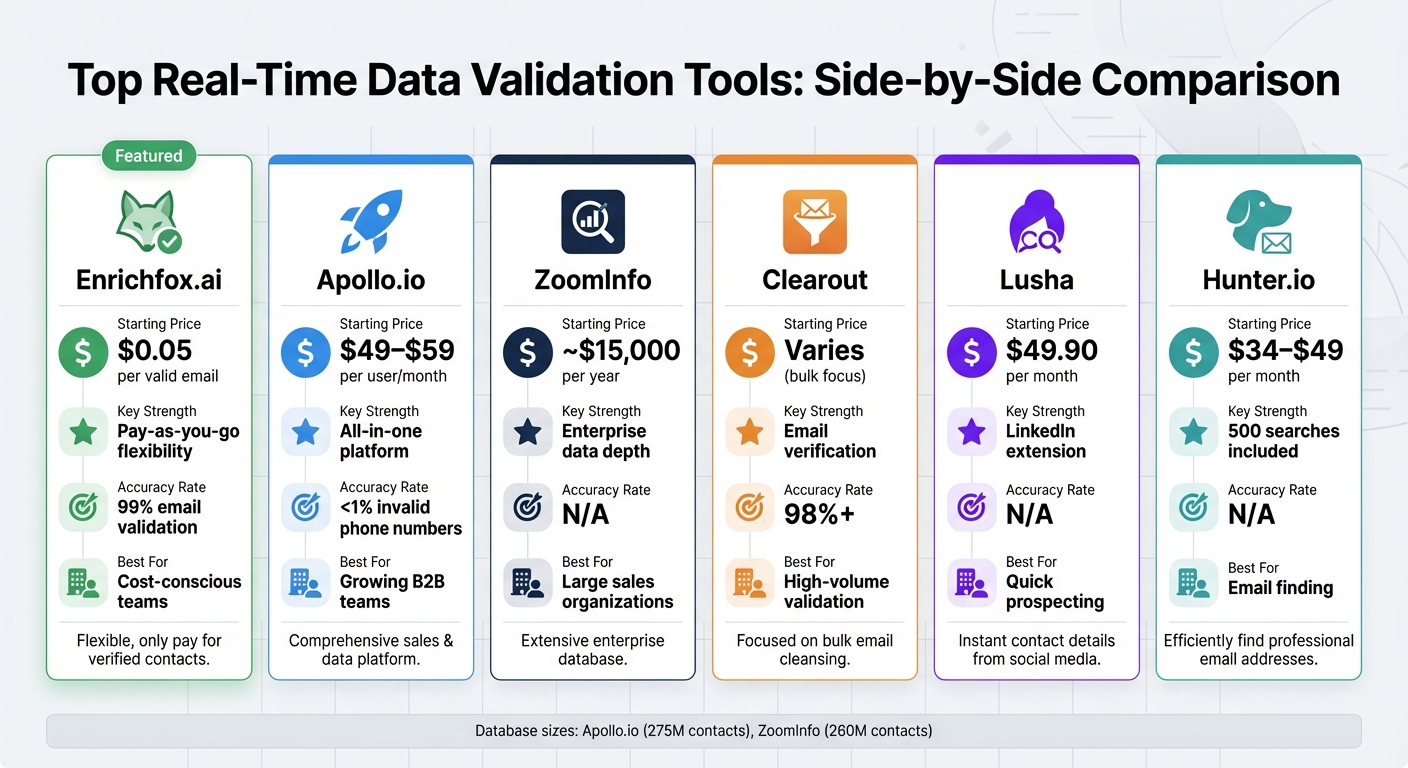
Real-Time Data Validation Tools Comparison: Features, Pricing & Accuracy
Tool Comparison: Features, Accuracy, and Pricing
When selecting a data validation tool, it’s important to weigh factors like team size, budget, and technical requirements.
Apollo.io provides a comprehensive platform with access to a database of over 275 million contacts. Its multisource verification ensures less than 1% of phone numbers are invalid. Pricing starts at $49–$59 per user per month, with a free plan for basic searches. According to Census, Apollo outperformed competitors like ZoomInfo, Clearbit, and Lusha in both data quality and cost efficiency.
ZoomInfo, on the other hand, caters to enterprise teams, offering detailed firmographic data and buyer intent signals for its 260 million contact database. However, at approximately $15,000 per year, it’s generally suited for larger organizations.
For those looking for flexible, usage-based pricing, Enrichfox.ai stands out. It charges $0.05 per valid email, $0.00025 per verified email, and $0.03 per valid phone number. This model ensures you only pay for what you use, while delivering 99% email validation accuracy.
If LinkedIn prospecting is your focus, Lusha offers a Chrome extension with plans starting at $49.90 per month for three users. Clearout specializes in email validation, boasting a 98%+ accuracy rate and a strong 4.8/5 rating on major review platforms. For budget-conscious teams, Datanyze is available at $29 per month for technographic tracking, and Hunter.io offers plans starting at $34–$49 per month for 500 searches.
Here’s a quick comparison to help you decide:
| Tool | Starting Price | Key Strength | Accuracy Rate | Best For |
|---|---|---|---|---|
| Enrichfox.ai | $0.05 per valid email | Pay-as-you-go flexibility | 99% email validation | Cost-conscious teams |
| Apollo.io | $49–$59 per user/month | All-in-one platform | <1% invalid phone numbers | Growing B2B teams |
| ZoomInfo | ~$15,000 per year | Enterprise data depth | N/A | Large sales organizations |
| Clearout | Varies (bulk focus) | Email verification | 98%+ | High-volume validation |
| Lusha | $49.90 per month | LinkedIn extension | N/A | Quick prospecting |
This table highlights the unique strengths of each tool, with Enrichfox.ai offering a standout combination of cost-effectiveness and high accuracy.
Why Enrichfox.ai Stands Out
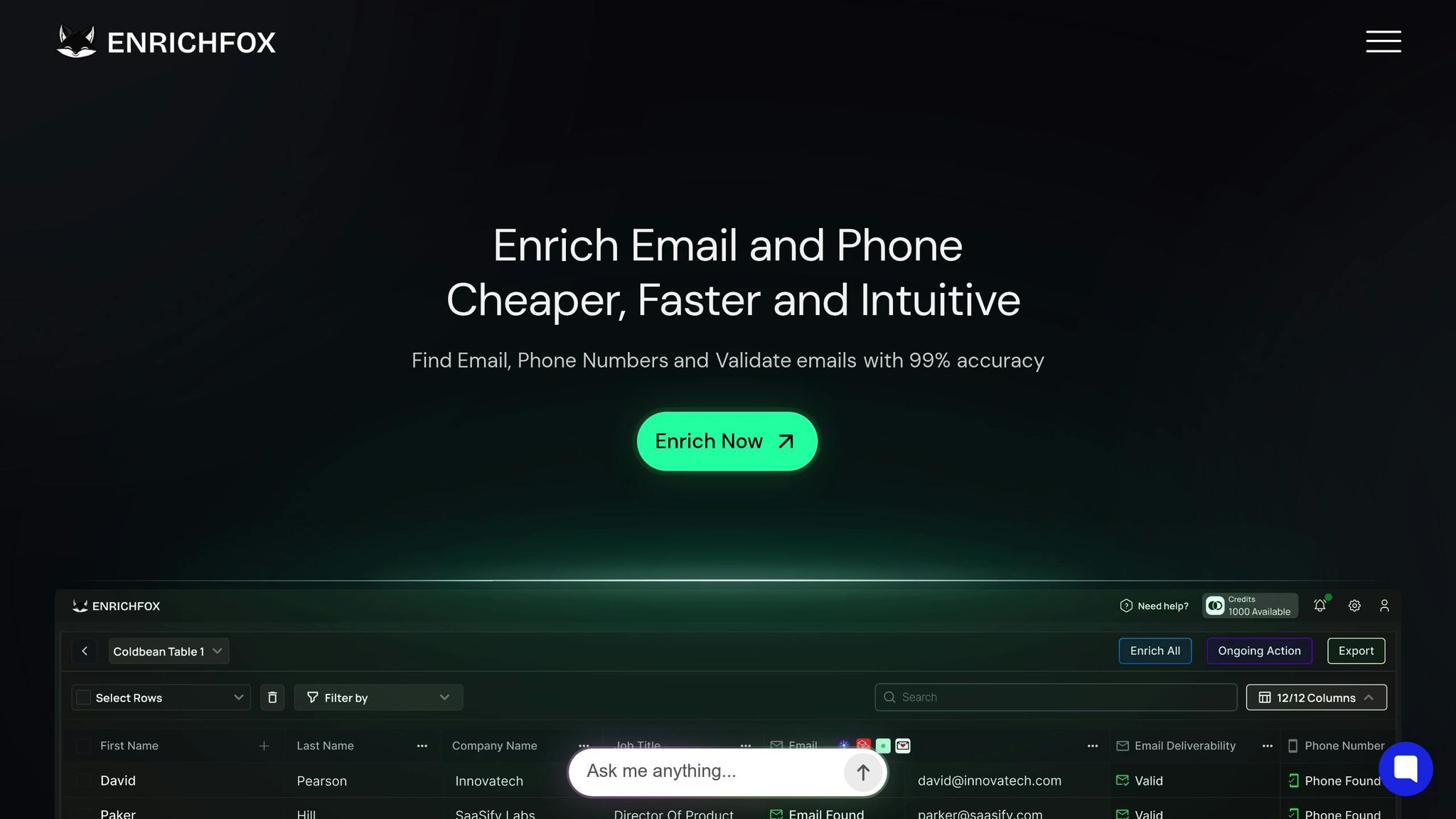
Enrichfox.ai addresses a common pain point with subscription-based tools: paying for unused credits. With its pay-as-you-go pricing - $0.05 per valid email, $0.00025 per verified email, and $0.03 per valid phone number - you only pay for successful validations. This flexibility is perfect for businesses with varying lead volumes or those exploring new markets.
The platform delivers 99% accuracy for email and phone enrichment, making it a reliable choice for maintaining clean lead data. Unlike enterprise tools that lock users into annual contracts, Enrichfox.ai offers API and webhook integrations for real-time validation without long-term commitments. Its bulk enrichment tools and CSV processing features simplify lead management, ensuring your CRM is populated with accurate, organized data.
For teams handling catch-all email addresses - those that accept all messages regardless of validity - Enrichfox.ai includes specialized detection to prevent wasted outreach efforts. With live chat support and easy CSV export options, it’s accessible even for teams without dedicated technical resources. By combining precision, affordability, and flexibility, Enrichfox.ai is a strong choice for small to medium-sized businesses looking to achieve enterprise-level data accuracy without the hefty price tag.
Best Practices and Common Pitfalls
Prioritizing High-Volume Lead Validation
When handling high-volume leads, it’s smart to use a tiered validation approach. For high-priority leads, like demo requests or account-based marketing (ABM) handraisers, apply real-time checks. For lower-priority nurture leads, batch validation helps control costs and keeps systems running smoothly.
Create a clear source hierarchy to guide validation efforts: Declared (user-provided data) > Enriched (third-party data) > Inferred (behavioral data). Combining validation with firmographic enrichment can produce "Fit Scores", which help prioritize leads that align well with your target audience - even if their engagement levels are low. Focus on automating the validation of critical fields, such as email addresses and phone numbers, before expanding to more complex data points. This layered approach lays the groundwork for integrating validation with dynamic enrichment processes.
Combining Validation with Data Enrichment
Validation ensures your data is accurate, while enrichment adds valuable context, making your leads more actionable. Using a waterfall strategy - where multiple data providers are engaged sequentially - can significantly increase email find rates, boosting them from around 40% to nearly 80%, compared to relying on just one provider. Pairing real-time validation with immediate enrichment can improve lead quality by 90% and enhance sales productivity by 60%.
To streamline the process, progressive enrichment can be a game-changer. By asking for only the most essential information upfront, you reduce form friction. Background processes then fill in the rest of the lead profile as prospects move through your funnel. Make sure your enrichment tools only append data to empty fields, avoiding overwriting any user-declared information. Standardizing formats - for instance, unifying "USA" and "United States" - before enrichment helps improve match rates. Keep an eye on match rates by provider and segment to identify any accuracy issues. Balancing thoroughness with speed is key - don’t let delays from over-validation slow you down.
Avoiding Over-Validation Delays
Over-validation can cause frustrating delays, especially when it slows down lead capture. For high-volume lead forms, skip One-Time Password (OTP) verification unless the offer is particularly high-value. While OTP ensures near-perfect accuracy, it often leads to a significant drop-off in leads. Instead, opt for invisible, API-based validation that works quietly in the background without disrupting the user experience.
Asynchronous API calls are another way to keep things moving. They allow form submissions to go through without waiting for validation responses. Have fallback routing paths in place to handle situations where validation fails - for example, if industry data isn’t available, route leads based on geographic location instead. Establish data quality SLAs (service-level agreements) between marketing and sales teams, such as ensuring 90% of leads are enriched within six hours. This keeps both teams aligned without creating bottlenecks. Regularly monitor API failure rates and provider match rates, as unaddressed gaps in enrichment can damage trust between teams.
"If your data is broken, everything else is too. Lead enrichment and data hygiene aren't side projects. They're the structural foundation of modern GTM execution." – LeadOps
With roughly 70.3% of B2B data decaying annually, keeping your data practices sharp is a must. Focus on validating what’s most important, enrich your data progressively, and remember - sometimes "good enough" is better than chasing perfection.
Conclusion
Real-time data validation plays a crucial role in every B2B marketing effort you undertake. By validating data at the point of entry, you can eliminate friction between sales and marketing teams, safeguard your brand reputation with better email deliverability, and ensure compliance with regulations like GDPR and CCPA. Plus, validated and enriched data can cut sales cycles by 20–30% while meeting the growing demand for personalization - something 80% of buyers now expect.
With B2B data decaying at an alarming rate of 70.3% annually, treating data quality as a shared responsibility between teams is no longer optional. Establishing operational agreements with clear SLAs and KPIs is key to maintaining high-quality data.
To tackle these challenges, start with practical solutions. Use API-based tools to validate data instantly and seamlessly at the point of entry. Create a clear source hierarchy - prioritizing declared data over enriched and inferred data - and set up real-time routing to ensure high-priority leads reach the right sales rep without delay. Pair validation with progressive enrichment by collecting only essential information upfront and filling in the gaps later. This approach reduces form abandonment while keeping your data accurate.
Advancements in technology are also reshaping how businesses approach data validation. AI-driven automation and consent-based enrichment are becoming standard. Tools like Enrichfox.ai, for example, deliver 99% accuracy in email and phone validations, offer bulk enrichment, integrate via API, and even identify catch-all emails - making it an excellent option for companies focused on lead quality. Whether you're processing thousands of new leads daily or cleaning up an outdated database, automated validation transforms your data into a valuable asset.
The key is to focus on what truly matters: validate critical fields first, enrich data progressively, and prioritize speed-to-lead over chasing perfection. Clean, actionable data from the start enhances everything from lead scoring to conversion rates, ensuring better outcomes across the board.
FAQs
How does real-time data validation enhance lead quality and reduce wasted marketing efforts?
Real-time data validation plays a crucial role in keeping your CRM clean and efficient. By weeding out invalid emails, inactive phone numbers, and duplicate entries as they come in, it ensures that only accurate, complete, and unique leads make it into your system. This directly boosts the quality of your lead database, paving the way for better engagement and more precise targeting.
When bad leads are removed from the equation, your marketing campaigns can zero in on genuine prospects. This helps ad platforms optimize for conversions while cutting down on wasted time and money spent chasing unqualified contacts. The result? Higher conversion rates and a more efficient use of your marketing budget.
Platforms like Enrichfox.ai stand out in this arena, offering precise email and phone number enrichment alongside tools designed for smooth lead management. With features such as API integrations and bulk validation, they provide businesses with practical and secure solutions to enhance lead quality and simplify workflows.
What’s the difference between real-time validation and bulk validation in lead management?
Real-time validation works by instantly checking and verifying data as it's entered, helping catch and correct errors on the spot. This is especially useful for fast-paced tasks like verifying an email address or phone number during form submissions. It also supports quick actions such as fraud detection or ensuring accurate shipping calculations. To function effectively, it relies on low latency and a solid infrastructure to keep workflows running smoothly.
Bulk validation, however, is designed to handle large volumes of data at scheduled intervals. This approach is more budget-friendly and works well for tasks like routine data cleaning, database migrations, or enriching existing records. While real-time validation shines when acting on fresh leads immediately, bulk validation is better suited for maintaining long-term data quality across large datasets.
Platforms such as Enrichfox.ai specialize in real-time validation, offering 99% accuracy for email and phone number verification, along with API and webhook integrations for instant enrichment. While competitors like Clay, Apollo, and ZoomInfo also provide data enrichment services, many focus primarily on bulk operations. This makes Enrichfox a standout option for businesses that prioritize real-time lead accuracy.
How can businesses integrate real-time data validation into their CRM systems for better lead management?
To bring real-time data validation into your CRM, start by connecting your lead capture forms to a validation service through an API or webhook. This setup allows the service to instantly verify and enhance key details - like email addresses and phone numbers - whenever new leads are added or existing records are updated. The result? Your CRM is filled with precise, high-quality data.
Consider using a provider like Enrichfox.ai, which offers 99% accuracy for validating emails and phone numbers. If you're looking for broader company-level data enrichment, alternatives like Apollo or ZoomInfo might be a better fit. Once you've chosen a provider, configure triggers for validation events, map the CRM fields to match the provider’s system, and ensure that any missing or incorrect data is promptly updated. This approach not only keeps your database accurate but also enhances lead quality, optimizes workflows, and helps your sales team work more efficiently.